
Focus on quality
'The winners of tomorrow are not the firms that adopt technology the fastest, but the firms that best connect technology, professional expertise and the human touch.'
- Rene van Diermen – The Finance Generation
A focus on quality builds trust.
A focus on innovation drives progress.
A focus on people creates sustainable growth.
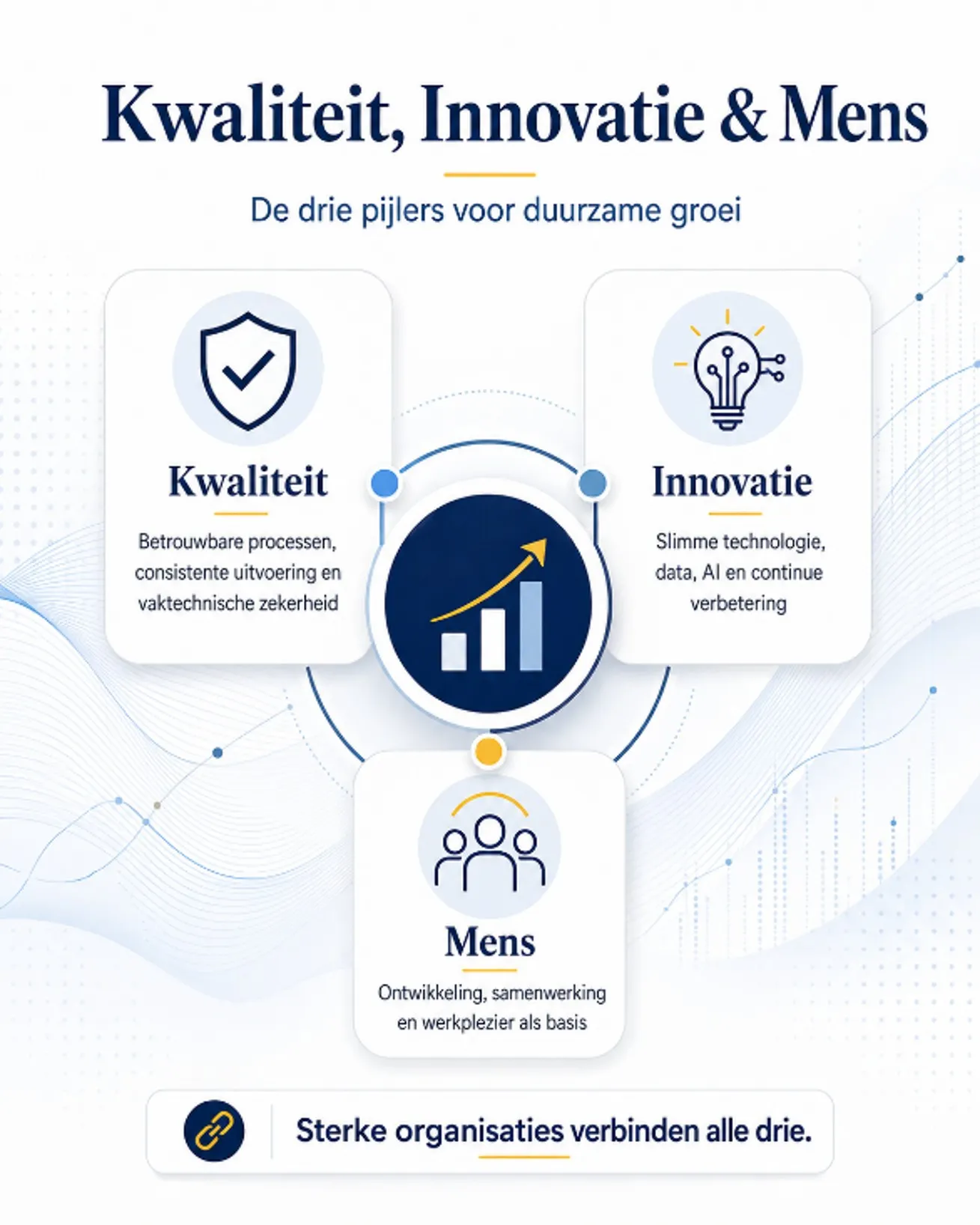
A focus on quality, a focus on innovation and a focus on people
The accounting sector is under pressure. The labour market remains tight, laws and regulations are becoming more complex, clients expect more insight and technology is developing faster than ever. For accounting firms, this means that carrying on as before is becoming less and less sustainable.
Yet the solution does not lie in more pressure, more hours or more stand-alone tools. The future of accounting calls for a different balance. A balance between three pillars that reinforce each other:
A focus on quality.
A focus on innovation.
A focus on people.
Firms that connect these three themes well are building an accounting practice that not only works more efficiently, but also becomes more attractive to employees and more valuable to clients.
A focus on quality: the foundation of trust
Quality is and remains at the core of the accounting profession. Clients, regulators, employees and society must be able to rely on the auditor’s work. That trust is built not only on technical knowledge, but also on consistent processes, sound documentation, clear review moments and professional judgement.
In practice, however, quality is often under pressure. Not because accountants consider quality less important, but because circumstances are becoming more complex. Deadlines are tight, teams are smaller, files are getting bigger and the volume of data keeps growing.
That is why quality today requires more than technical knowledge. It requires structure.
Accounting firms need to take a critical look at their work processes. Which tasks are performed manually over and over again? Where do errors or delays occur? Where is standardisation lacking? And where is human judgement truly necessary?
A focus on quality means organising work so that people spend their time on the areas where their expertise adds the most value. Not endlessly collecting data, retyping it or checking standard items, but exercising professional judgement, connecting the dots, recognising risks and substantiating conclusions.
Quality does not come from working harder. Quality comes from organising smarter.
A focus on innovation: technology that strengthens the profession
Innovation is not an end in itself. It is not about an accounting firm using the latest tool, but about technology helping to make the work better, more consistent and more future-proof.
AI, data analytics, automation and standardised work programmes offer great opportunities. Think of analysing general ledger data faster, identifying unusual transactions, preparing files, linking documents to line items or supporting risk assessments.
But innovation requires direction. Without a clear vision, you end up with fragmentation: stand-alone tools, isolated experiments and employees who each work in their own way. Efficiency may increase temporarily, but so does the risk of inconsistency, unclear responsibilities and loss of quality.
The real value of innovation comes when technology is embedded in the process.
That means:
- making clear choices about which processes you want to improve;
- unlocking data in a secure and structured way;
- always having AI output reviewed by professionals;
- developing standards for use, validation and documentation;
- training employees to apply new technology responsibly.
Innovation does not replace the accountant. Innovation strengthens the accountant.
By using technology smartly, you create more room for analysis, interpretation, client conversations and professional judgement. This does not make the profession less substantive; it makes it more relevant.
A focus on people: sustainable growth starts with employees
In all the discussions about quality and innovation, one element must never be overlooked: people.
Accounting is and remains a people business. Clients do not place their trust in a system, but in the professional who understands and assesses that system and translates it into meaningful insights. Employees do not just want to complete files; they want to learn, grow and contribute to work that matters.
At the same time, many accounting firms are under pressure in terms of capacity, job satisfaction and talent retention. A high workload, peak periods and repetitive tasks make it difficult to retain people for the long term.
That is why innovation must always go hand in hand with people-centred organisation.
Technology should support employees, not replace them. Standardisation should bring calm, not rigidity. New working models should contribute to better collaboration, more development opportunities and a healthier distribution of work.
A focus on people means that firms invest in:
- training and guidance;
- clear roles and expectations;
- collaboration within teams;
- room for professional judgement;
- reducing workload;
- personal development;
- a culture in which feedback is the norm.
By investing in these areas, you build not only better processes, but also stronger teams.
The strength lies in the combination
Quality, innovation and a people-centred approach are still too often seen as separate themes. But the real strength lies in combining them.
Without quality, innovation becomes risky.
Without innovation, quality comes under pressure.
Without attention to people, no model is sustainable.
A future-proof accounting firm connects these three pillars in a single way of working.
That means using technology to raise quality. Standardising processes to give employees room. Using data to provide better advice. Using AI to reduce repetitive work. And training teams so they become stronger in their professional role.
The accountant of the future is no less expert, but works differently. Less time goes into manual preparation and standard checks. More time goes into assessment, analysis, advice and client value.
The future of accounting calls for choices. Firms that keep relying on old ways of working will feel increasing pressure on capacity, quality and job satisfaction.
Firms that invest in quality, innovation and people are building a stronger foundation.
A focus on quality builds trust.
A focus on innovation drives progress.
A focus on people creates sustainable growth.
The winners of tomorrow are not the firms that adopt technology the fastest, but the firms that best connect technology, professional expertise and the human touch.
Rene van Diermen